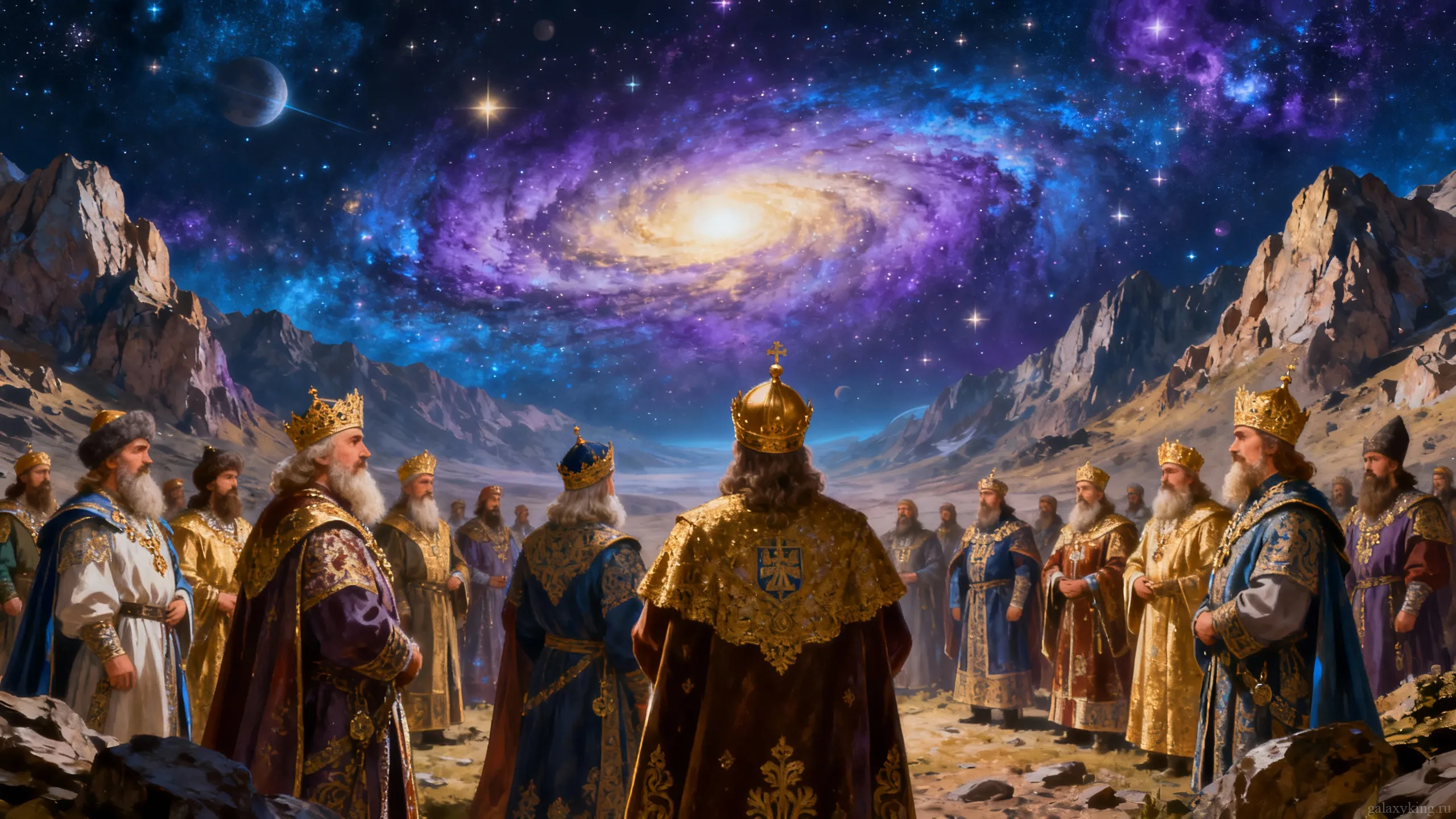
The question of the best form of government has remained relevant for centuries. Let’s compare two fundamentally different models — absolute monarchy and federation — according to key parameters to understand their strengths and weaknesses.
What are they?
- Absolute monarchy is a form of government in which supreme power is concentrated in the hands of one person (the monarch) and is passed down through inheritance. Classical historical examples include the Russian Empire before 1905 and France during the reign of Louis XIV.
- Federation is a form of state structure where power is distributed between the central government and regional entities (states, lands, republics). Examples: the USA, Germany, Russia.
Management efficiency
Absolute monarchy:
- Speed of decision-making. The absence of coordination requirements allows for a swift response to crises.
- Unity of policy. A long-term strategy does not depend on changes of rulers (provided the heir is properly educated).
- Risk of subjectivity. The monarch’s mistakes are not compensated by a system of checks and balances.
Federation:
- Balance of interests. Regional authorities take local specifics into account.
- Checks and balances. The separation of powers reduces the risk of arbitrariness.
- Bureaucratisation. A multi-level system may slow down decision-making.
Stability and continuity
Absolute monarchy:
- Stability of policy. With a clear order of succession, politics remain predictable for decades.
- Succession crisis. The struggle for power among contenders can lead to unrest.
- Dependence on personality. The quality of governance directly depends on the monarch’s abilities.
Federation:
- Institutional resilience. The system continues to function when leaders change.
- Political competition. Regular elections provide an opportunity to adjust the course.
- Regional conflicts. Disagreements between the centre and the regions can destabilise the country.
Civil rights and freedoms
Absolute monarchy:
- Limitation of pluralism. Sole authority suppresses the opposition.
- Estate inequality. Traditionally entrenches privileges for certain groups.
- Paternalism. The monarch may act as the ‘father of the nation’, caring for subjects.
Federation:
- Guarantees of freedoms. The constitution protects the rights of citizens and minorities.
- Democratic mechanisms. Elections, referendums, local self-government.
- Rule of law. The supremacy of law over the will of individuals.
Economic development
Absolute monarchy:
- Centralised planning. Enables the implementation of large-scale projects (infrastructure construction, territory development).
- Corruption. Lack of control fosters abuses.
- Conservatism. Resistance to innovation due to reliance on traditions.
Federation:
- Economic competition among regions. Stimulates development.
- Flexibility. Regions can experiment with economic models.
- Imbalance. The gap between rich and poor regions requires resource redistribution.
National and cultural policy
Absolute monarchy:
- Unified ideology. Promotes societal consolidation.
- Assimilation of minorities. Suppression of regional cultures for the sake of unity.
Federation:
- Diversity. Takes into account the interests of different ethnic groups and regions.
- Potential for separatism. Excessive autonomy may threaten the integrity of the state.
Historical examples
- Absolute monarchy. The Russian Empire achieved great power under centralised rule, but the crisis of the early 20th century revealed the system’s vulnerabilities.
- Federation. The USA and Germany demonstrate how a federal structure promotes the development of democracy and economy, although they face challenges (e.g., secession crises).
Modern realities
Today, pure forms of absolute monarchy have survived in only a few countries (Saudi Arabia, Oman), where they have been adapted to local traditions. Most developed states have chosen federal or parliamentary models that combine stability and democracy.
Conclusion
There is no unambiguous answer to the question ‘which is better?’ — the choice depends on the goals, context, and values of society:
- Absolute monarchy is suitable for:
- societies with strong traditions and religious foundations;
- countries in need of rapid resource mobilisation (wartime, large-scale reforms);
- cultures where the leader’s authority has a sacred character.
- Federation is optimal for:
- multinational and multicultural states;
- economies requiring innovation and regional initiative;
- societies that value civil liberties and participation in governance.
In the long term, the federal model appears more resilient due to its built-in adaptation mechanisms. However, its success depends on the maturity of institutions, legal culture, and citizens’ willingness to compromise. Absolute monarchy may yield short-term effects but carries risks of stagnation and legitimacy crises.
Thus, the ‘best’ system is the one that aligns with the historical experience, scale, and needs of a particular state. There is no ideal model: each has its own advantages and limitations, requiring a balanced approach when choosing a development path.
The Anointed Tsar
In previous sections, we compared traditional forms of government — absolute monarchy and federation. Now let’s imagine an alternative model — the ‘Anointed Tsar’, which combines elements of monarchy with innovative social and economic mechanisms. Let’s examine its key principles and assess its potential.
Concept of the ‘Anointed Tsar’
The model envisages monarchical power 👑 with expanded social responsibility of the ruler, relying on direct mechanisms of popular participation and transparent economic processes.
Key elements of the model
Court without formal laws
- Principle: absence of codified laws. The judge delivers a verdict in each specific case, relying on the decisions of ten jurors — ‘thousandsmen’ — selected by their sector (district, community, etc.).
- Goal: to eliminate loopholes in the law and ensure justice through an appeal to common sense and moral norms.
- Mechanism:
- ‘thousandsmen’ are ordinary citizens randomly selected from their sector;
- the judge summarises their verdicts and formulates the final decision;
- precedents do not create binding norms but may be considered in similar cases.
Pros: flexibility, consideration of situational nuances, minimisation of legal loopholes.
Cons: risk of subjectivity, dependence on the moral level of jurors, difficulty in predicting decisions.
Unified accounting system 💵📊
- Principle: full transparency of financial flows. Money does not pass through third parties; all transactions are recorded in a unified system.
- Implementation:
- each employee has a fixed rate plus a coefficient (includes all payments: salary, social guarantees, transport, utilities, etc.);
- all expenses are covered by the unified accounting system: healthcare, transport, taxes, utilities, education, and other social needs;
- no separate payments — all expenses are managed through the unified accounting system.
- Effect: impossibility to ‘launder’ money, reduction of bureaucracy, simplification of calculations.
Labour policy 👷♂️👷♀️
- Mandatory employment: all officially unemployed individuals are assigned to public works (infrastructure, ecology, social projects).
Personal card — universal identifier
- Functions: combines passport, driver’s licence, bank card 🔑💳, ОМС policy, travel pass, etc.
- Technologies: a chip-equipped card.
- Advantages:
- no need to carry multiple documents — everything is on one card;
- instant verification by police (via mobile device) 🚔;
- Risks: threat of data leaks, potential misuse of control.
Comparison with traditional models
| Criterion | Absolute monarchy | Federation | Anointed Tsar |
|---|---|---|---|
| Decision-making speed | High | Medium | High (monarch + direct mechanisms) |
| Flexibility of law | Low (strict laws) | Medium (amendments) | High (court without laws) |
| Economic transparency | Depends on the monarch | Partial (taxes, audits) | Maximum (unified accounting) |
| Social protection | Paternalism | Through taxes and programmes | Built-in (coefficients, public works) |
| Civil liberties | Limited | Constitutional guarantees | Balance (control vs. convenience) |
Potential risks and challenges
- Abuse of power. The monarch may manipulate the jury system or adjust coefficients in favour of loyal groups.
- Technological vulnerability. The unified accounting system and personal cards require the highest level of cybersecurity.
- Social tension. Mandatory public works may be perceived as forced labour.
- Ethical issues. A court without laws risks becoming a tool for subjective justice.
- Scalability. The model is difficult to adapt for multinational states with diverse traditions.
Possible areas of application
The concept is best suited for:
- small states with a high level of digitalisation;
- societies where traditions are combined with a willingness to conduct technological experiments;
- transitional periods after crises (when old laws have been discredited).
Conclusion
The ‘Anointed Tsar’ model is an experimental synthesis of monarchical stability, popular participation, and digital technologies. It offers radical solutions to the problems of bureaucracy, corruption, and social insecurity. However, its success depends on:
- the integrity and wisdom of the monarch 👑;
- the maturity of civil society 🤝;
- the reliability of technological infrastructure 💻.
In comparison with classical models:
- surpasses absolute monarchy in flexibility and transparency 🔎;
- is more efficient than a federation in terms of decision-making speed and bureaucracy reduction 🗂️;
- but requires high responsibility from both the ruler and citizens.
This model is not a universal solution, but a provocation for a discussion on how traditional forms of power can adapt to the challenges of the 21st century. Its implementation is only possible under the condition of a balance between authoritarian efficiency and democratic control mechanisms.
💬 What do you think? Which model seems the most viable to you? Share your opinion in the comments! 👇